Saturday, April 30, 2022

Philippine Soldier and 5 Suspected Islamic State Militants Killed in Lanao del Sur

Philippine Soldier and 5 Suspected Islamic State Militants Killed in Lanao del Sur.lelemuku.com.jpg
A mannequin dressed as a sniper is placed beside a sign for the Islamic State-aligned militant Maute Group near a military checkpoint at an abandoned neighborhood during an ongoing clean-up of Marawi city in southern Philippines, Oct. 19, 2017. - (AP) 
MANILA, LELEMUKU.COM - Five suspected pro-Islamic State militants and a soldier were killed in a gunbattle when government forces stormed the extremists’ jungle camp in the southern Philippines, the military said Friday.

The clash that took place on Thursday outside the remote town of Butig in Lanao del Sur province was the deadliest during the holy month of Ramadan involving suspected Islamic militants. Ramadan in the Philippines ends on Sunday evening.

“Five members of the Daulah Islamiyah-Maute Group were killed,” said Brig. Gen. Jose Maria Cuerpo II, commander of the 103rd Infantry Brigade, adding that a soldier was killed and a second was injured during the intense ground and air attacks.

“Daulah Islamiyah” means “Islamic State” in the local language. The group has members from several Filipino militant factions including the Maute Group fighting out of Lanao.

Cuerpo said the troops launched the operation following reports from residents weeks ago about the presence of armed men in the mountainous part of the village of Ragayan. Those complaints corroborated intelligence reports about an alleged terror group stockpiling construction materials and food supplies in the area.

“The encounter is proof that the terrorists are out to disrupt the peace whenever they are capable,” Cuerpo told reporters.

“It is for this reason that the Army is aggressive in its counter-terrorism operations. We will never let them succeed. Despite the unfortunate loss of one of our brothers-in-arms, we will never abandon the fight against terrorists wherever they may be.”

In May 2017, Maute group leaders and others launched the siege of Marawi, the capital of Lanao del Sur, joined by militants from the Middle East and Southeast Asia. The attack lasted five months and as many as 1,200 militants, troops, and civilians were killed before the military, supported by foreign intelligence, regained control of the southern Philippine city.

Five years later, some areas of Marawi continue to remain inaccessible because of unexploded ordnance that has yet to be removed. Thousands of citizens remain in transitional centers.

Four-hour clash


Local battalion commander Lt. Col. Romulus Rabara, who led the assault on Thursday, said about 40 members of the Maute Group were present in the area, precipitating a four-hour gunbattle.

Troops attacked with rounds of heavy artillery, Rabara said Friday, adding that Air Force attack helicopters provided air support to the ground offensive.

Rabara told reporters he believed other enemy fighters could have been injured, based on radio monitoring on the ground.

After the clash, troops recovered four high-powered firearms, including a rocket-propelled grenade launcher, ammunition, and improvised landmine and other materials.

Since January across the southern Philippines, troops have killed nearly 70 Daulah Islamiyah militants, 109 Bangsamoro Islamic Freedom Fighters (BIFF), and 49 Abu Sayyaf extremists, according to military records.

BIFF is a breakaway of the Moro Islamic Liberation Front, a former separatist group that signed a peace deal with the government and heads a transitional government in a Muslim autonomous region in the south. Abu Sayyaf is known for kidnappings, beheadings and bomb attacks. One of its factions is allied with the Islamic State.

A large Muslim minority lives in the southern part of the Philippines, Asia’s only predominantly Catholic nation. (Jeoffrey Maitem | BenarNews )

Labels:

Japan PM, Fumio Kishida Begins SE Asia Trip, Urges Open Seas and Response on Ukraine

Japan PM, Fumio Kishida Begins SE Asia Trip, Urges Open Seas and Response on Ukraine.lelemuku.com.jpg

JAKARTA, LELEMUKU.COM - Japan’s leader made a veiled but strong statement against Chinese assertiveness as he met Indonesia’s president on Friday at the start of a trip to Southeast Asia and Europe to promote a free and open Indo-Pacific and rally a regional response to the Ukrainian crisis.

Tokyo is also considering giving Indonesia patrol boats so its coast guard could strengthen maritime security, Prime Minister Fumio Kishida said, amid Chinese pressure on Jakarta over its oil and gas drilling operations in its own exclusive economic zone in the South China Sea.

“I expressed a strong sense of protest against efforts to change the status quo unilaterally and economic pressures in the East China Sea and South China Sea,” Kishida said, after meeting with President Joko “Jokowi” Widodo in Jakarta.

The Japanese premier’s remarks were a pointed reference to concern over Chinese activities in the region.

Kishida’s eight-day tour will see him visiting “strategic ASEAN partners,” including Vietnam and Thailand.

The prime minister will then proceed to Europe, with stops in Italy and the United Kingdom, both members of the G7 grouping of industrialized countries that also comprises Japan.

Before embarking from Tokyo on his trip, Kishida said at the airport that he would like to “exchange frank opinions on the situation in Ukraine with each of the leaders and confirm their cooperation.”

Indonesia is host of this year’s Group of 20 summit in November, an engagement that has placed Jakarta in a diplomatic bind, amid opposition to the participation of Russia because of its invasion of Ukraine and alleged war crimes there.

On Friday, Jokowi confirmed that Indonesia had invited Ukraine’s president as a guest to the G-20 summit in Bali and that Russian leader Vladimir Putin would also attend.

Kishida said he and Jokowi “exchanged views openly” on the Russian invasion, “which is a clear violation of international law and which we say has shaken the foundations of the international order, including Asia, and must be strongly condemned.”

“Keeping in mind the U.N. resolutions agreed upon by the two countries, I and the president discussed this issue. We have one understanding that a military attack on Ukraine is unacceptable. In any area, sovereignty and territorial integrity should not be interfered with by military force or intimidation,” the Japanese leader said.

Jokowi, for his part, called for all countries to respect sovereignty and territorial integrity.

“The Ukraine war must be stopped immediately,” he said.

A regional ‘reluctance to take sides’


The war in Ukraine has been a divisive issue among members of the Association of Southeast Asian Nations, or ASEAN.

“Across the region there is a reluctance to take sides and an ambivalence about the concert of democracies lining up in support of Ukraine,” said Jeff Kingston, a professor and director of Asian Studies at Temple University in Tokyo.

Most Southeast Asian countries – Singapore being an exception – have been hesitant to condemn Russia or join international sanctions against Moscow. Japan hopes to consolidate their responses during the prime minister’s visit.

“Kishida will [also] seek to gain understanding of what is at stake and the potential implications for Asia in terms of China’s hegemonic aspirations,” Kingston said.

China’s increasing assertiveness in the East China and South China seas will be high on the agenda, and Kishida said he would discuss with Southeast Asian leaders further cooperation “toward realizing a free and open Indo-Pacific,” and maintaining peace and order.

Stops in Hanoi, Bangkok


In Vietnam, where Kishida will spend less than 24 hours over the weekend, he will meet with both the Vietnamese prime minister and president.

Bilateral talks will focus on post-COVID-19 and security cooperation, Vietnamese media said. Vietnam shares interests with Japan in safeguarding maritime security in the South China Sea where China holds expansive claims and has been militarizing reclaimed islands.

In Thailand, Kishida will hold talks with Thai Prime Minister Prayuth Chan-o-cha. Thailand is the host of the Asia-Pacific Economic Cooperation (APEC) forum summit in November.

Bangkok and Tokyo are celebrating the 135th anniversary of diplomatic ties this year, and the two sides are seeking to sign an agreement on the transfer of defense equipment and technology to strengthen cooperation in the security field, according to the Bangkok Post.

Government spokesman Thanakorn Wangboonkongchana said it would be the first official visit of a Japanese prime minister to Thailand since 2013.

In March, Kishida visited India and Cambodia, his first bilateral trips since taking office in October 2021.

Later in May, he will host a visit by U.S. President Joe Biden and a summit of the Quadrilateral Security Dialogue, or Quad.

The White House announced on Wednesday that President Biden would visit South Korea and Japan May 20-24 to advance a “commitment to a free and open Indo-Pacific and to U.S. treaty alliances” with the two countries.

The trip will be Biden’s first one to Asia as president.

“In Tokyo, President Biden will also meet with the leaders of the Quad grouping of Australia, Japan, India, and the United States,” the statement said without disclosing the date.

The Quad is widely seen as countering China’s weight in the region.

China has been sneering at the formation of the Quad, calling it one of the “exclusive cliques detrimental to mutual trust and cooperation among regional countries.”

On Thursday, Chinese Foreign Ministry’s spokesman Wang Wenbin said that the Quad “is steeped in the obsolete Cold War and zero sum mentality and reeks of military confrontation.”

“It runs counter to the trend of the times and is doomed to be rejected,” he said. (Dandy Koswaraputra | Radio Free Asia / BenarNews)

Labels:

Thursday, April 28, 2022

Philippines Disbands 20 Private Armed Groups Ahead of May 9 General Election

Philippines Disbands 20 Private Armed Groups Ahead of May 9 General Election.lelemuku.com.jpg
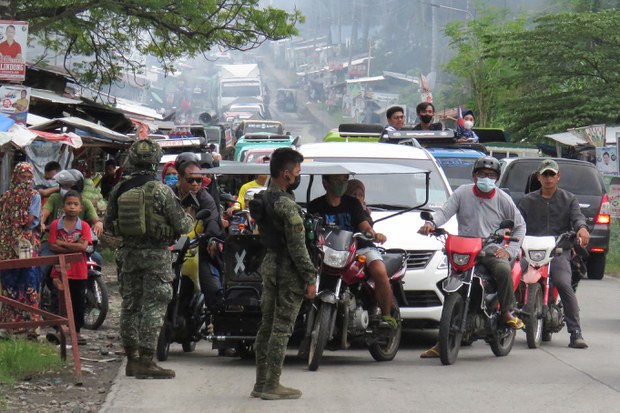
 Philippines disbands some private armed groups ahead of May 9 election Philippine soldiers man a checkpoint in Lanao del Sur province ahead of the May 9 General Election, April 25, 2022 - (AFP)

MANILA, LELEMUKU.COM - Authorities in the Philippines have disbanded about 20 private armed groups working for politicians over concerns about potential poll-related violence ahead of the May 9 general election, the national police said Tuesday.

Meanwhile, the election commission announced it was taking control in another eight municipalities to directly supervise polling officials and oversee security for the upcoming vote.

Most of the disbanded armed groups were from an autonomous Muslim region in the south, where some members of gun-for-hire organizations are known to have links to militants, police spokeswoman Col. Jean Fajardo told a Manila radio station.

“More or less, we have dismantled about 20 from our list of private armed groups,” Fajardo said, emphasizing that some of the armed men “are members of local terrorist groups who hire themselves out during elections to politicians.”

Police and the military had carried out focused operations since the start of the year, she said, adding that politicians known to have employed these gunmen would be charged in court.  

“At the moment, we have not monitored any credible threats, so to speak, that could disrupt the election,” she said. “Nonetheless, we will not let our guard down, and intelligence monitoring and gathering are being carried out with our AFP [military] counterparts and other law enforcement agencies.”

Last year, police had identified about 155 private armed groups across the Philippines, half of which, officials said, were highly active.

The constitution stipulates that private armies and other groups not recognized by the government shall be dismantled.

Comelec action

Also on Tuesday, the Commission on Elections (Comelec) announced that it was placing under its control another six municipalities in Maguindanao province, along with a city and municipality in Lanao del Sur province, according to the state-run Philippine News Agency (PNA).

Comelec has assumed direct control of electoral supervision and law enforcement agencies for the safeguarding and integrity of polls in at least 20 municipalities, mostly in the south and the Bangsamoro Autonomous Region in Muslim Mindanao in the run-up to the vote, according to officials. The national polls body took similar action in municipalities ahead of the 2016 general election.

“As regards to other areas, we are continuously upgrading and updating our assessment status,” said Saidamen Pangarungan, the chairman of Comelec, according to PNA.

Under an updated resolution adopted in January, Comelec may place any political division under its direct control and supervision. Leading up to the election, “it shall exercise full control and supervision over all national and local law enforcement agencies as well as military officers and men assigned in the political division, subdivision, unit or area concerned.”

The resolution, among other things, allows Comelec to take action in communities:  That have a history of or current intense rivalries that could motivate people to engage in violent acts; That have had incidences of politically motivated violence involving candidates and/or supporters; And that could have violence “facilitated by the employment of private armed groups.”

The Philippines, with its long-running gun culture, coupled with feuding clans in tribal areas as well as rival political dynasties trying to outdo each other, has seen gun-for-hire groups commit violence in advance of elections.

During the 2016 general election, as many as 50 people died in poll-related violence, according to police statistics. Three years later, during the 2019 midterm election, 23 people were killed and 50 injured.

The bloodiest election-related violence occurred in November 2009 when members of the Muslim Ampatuan clan massacred 58 members of their rival clan, the Mangudadatu, their supporters and local journalists.

In December 2019, dozens of Ampatuan clan-members were convicted of murder, but more than 50 others – including dozens of police officers and body guards in the employ of the Ampatuans – were acquitted.

Some relatives and members of the Ampatuan clan are back in power and will be contesting local posts in Mindanao next month.

Duterte: ‘I will arrest you and your body guards’

About 65 million Filipinos are registered to vote on May 9 to elect President Rodrigo Duterte’s successor along with 12 members of the Senate, 316 members of the House of Representatives as well as thousands of officials including governors, mayors, village chiefs and council members.

Last week, Duterte warned candidates to follow election laws, saying that maintaining more than two bodyguards constitutes maintaining a private army.

“We have decided and have communicated this with the cabinet. ... The rule should really be followed… that more than two bodyguards would be considered a private army,” Duterte said.

“And if you think there is danger to your person and a certain place or person, call the regional director, call the chief of police and discuss matters to prevent quarrels and the use of guns,” he said.

Duterte vowed to let authorities arrest those candidates who would stoke violence during the remainder of the election season.

“I will arrest you and your bodyguards. Remember, the government will not allow terrorism in this election. We are not taking sides. We will enforce the law to make the elections peaceful,” he said. (Jeoffrey Maitem/ Froilan Gallardo| BenarNews)

Labels:

Sunday, April 24, 2022

Chinese Development Bank to Fund Overrun for Jakarta Bandung High-Speed Rail Line

Chinese Development Bank to Fund Overrun for Jakarta Bandung High-Speed Rail Line.lelemuku.com.jpg

JAKARTA, LELEMUKU.COM - Indonesia will ask the China Development Bank to finance 75 percent of the nearly U.S. $2 billion cost overrun for the construction of a Beijing-backed fast train project linking the capital Jakarta with Bandung, a project official said Thursday.

The cost of the rail line, which is now projected to be completed next year, has swelled to nearly $8 billion. The project is part of the Belt and Road Initiative, China’s $1 trillion-plus program to finance and build infrastructure projects across the globe.

“Obviously the first one to be offered is CBD [China Development Bank], the lender financing 75 percent of the project,” said Dwiyana Slamet Riyadi, president director of the consortium, PT Kereta Cepat Indonesia China (KCIC), according to a report by Tempo, the Indonesian news outlet.

Dwiyana said the Indonesian government had proposed that the same financing structure apply to the cost overrun, with the consortium covering 25 percent.

KCIC is a joint venture of a consortium of four Indonesian state-owned companies – KAI, Wijaya Karya, PTPN VIII, and Jasa Marga – and a consortium of Chinese companies.

The Indonesian consortium controls 60 percent of KCIC, while China Railway Engineering Corp. and other Chinese companies control the rest.

The 89-mile (143.2-km) Jakarta-Bandung rail line is expected to slash travel time between the Indonesian capital and Bandung from three hours to 40 minutes, officials have said.

In January, President Joko “Jokowi” Widodo said the project was expected to be operational by June 2023.

The contractor, meanwhile, said the project was 82 percent complete.

Since construction began in 2017, the project has been dogged by criticism about its impacts on surrounding areas as well as concerns about rising costs.

On Wednesday, Minister of Transportation Budi Karya Sumadi witnessed the laying of the first section of track for the rail link in West Java.

Last October, Jokowi decided to allow the government to share the cost of the railway project, contradicting an earlier pledge and decree in 2015 that prohibited the use of state funds for its construction. A presidential spokesman said Jokowi’s directive would allow the project to be completed.

A month later, the finance minister told a parliamentary panel that the government had decided to inject 4.3 trillion rupiah ($299 million) into the project. Critics had expressed concern that the move could deplete state coffers and lead Indonesia into a debt trap.

Yusuf Rendy Manilet, an economist at the Indonesian Center for Reform of Economics, a private think-tank, said renegotiating funding for the project is necessary.

“The government should also look at whether the risks [to state coffers] remain the same or there are adjustments or additional risks,” Yusuf told BenarNews.

The economist said potential overruns should have been agreed upon during the project’s planning stage.

“This needs to be especially noted considering that China will become one of Indonesia’s main economic partners in the next few years,” Yusuf said.

Now, the government and other stakeholders need to recalculate the cost because of the overrun, he said.

Knock-on effects from capital move


In February, the consortium said the high-speed rail service was expected to become profitable 40 years after completion – not 20 as earlier projected – partly because plans to move the national capital from Jakarta to Borneo could sharply reduce the number of riders.

Moving the seat of government away would cut the projected number of passengers using the railway connecting Jakarta to Bandung in West Java nearly in half because many government employees are expected to relocate to the new capital, a company spokesman said.

An AidData study released last year noted that Indonesia owes $17.28 billion in “hidden debt” to China, more than four times its $3.90 billion in reported sovereign debt.

Nearly 70 percent of China’s overseas lending is directed to state-owned companies and private-sector institutions and the debts, for the most part, do not appear on government balance sheets, said the U.S.-based international development research lab. (Dandy Koswaraputra | BenarNews)

Labels:

Malaysian Media and Officials Urged not to Fan Hatred of Rohingya

Malaysian Media and Officials Urged not to Fan Hatred of Rohingya.lelemuku.com.jpg

KUALA LUMPUR, LELEMUKU.COM -Malaysian police have detained two Rohingya they suspect of having instigated a riot and mass breakout at a detention center that led to six escapees being fatally struck by vehicles on a highway in the middle of the night, authorities in northern Kedah state said Friday.

Eighty-eight Rohingya remained at large, including nine women and eight children, according to police chief Wan Hassan Wan Ahmad, who urged local people not to help them. Sheltering people who violate immigration laws is punishable by up to 10 years in prison, he said.

“It’s been three days. These people are hungry, barefoot. They will not be able to last, with children in tow. We ask the public to immediately report to the police if any refugees seek help from them,” he said.

A total of 287 officers in three states – Kedah, Penang and Perak – have been mobilized to look for the remaining escapees, Wan Ahmad said.

Meanwhile, amid ongoing updates about the manhunt, a Malaysian media advocacy group urged local officials and media not to use language that could foster hatred or fear of Rohingya people.

“Publishing authorities’ comments that label Rohingya detainees as ‘highly dangerous’ … or that ‘they may also act out of control to survive’ presents the detainees as ‘violent and irrational,’” said a statement by the Malaysia-based Center for Independent Journalism (CIJ).

Reporters should “interrogate the root causes behind the breakout, and not … sensationalize the issue by framing it as a crime,” it said.

“While we understand the need for balanced and accurate reporting, there is a fine line that could potentially trigger increasing xenophobia and discrimination,” CIJ executive director Wathshlah Naidu she told BenarNews.

Death hours before riot being investigated


On Thursday, Kedah Criminal Investigation Department chief G. Suresh Kumar said the riot occurred hours after a detainee died at the Sungai Bakap Temporary Immigration Depot.

“For the record, there was a death involving a detainee in his 30s late at night, hours before the early morning rioting took place. We are conducting a post-mortem on the body and until we have the autopsy report, I wish to call on everyone to refrain from speculating,” he said.

“So far, what we know is that the escapees only wanted their freedom and it was not because they were unhappy with the camp management,” he said.

No serious injuries were reported in the riot early Wednesday, officials said then, adding that security personnel on duty were quickly overwhelmed as 528 people escaped. Two children were among the six later struck and killed on a highway about six km (3.7 miles) away.

Most of the escapees have since been captured and taken to a detention facility in Semenyih, Selangor, about 350 kilometers (218 miles) from the place they escaped.

“We have taken statements from 420 Rohingya detainees and also took their fingerprints for record. [The riot occurred] probably due to congestion and having been in detention for too long,” Wan Ahmad, the police chief, said Friday.

On Wednesday, Home Minister Hamzah Zainudin had said the Rohingya who broke out of the detention center were brought there after being apprehended in Langkawi, off the coast of Kedah, in 2020.

But the Kedah police chief on Friday said the main instigator of the unrest had been there three years – and was transferred there from another immigration facility.

“He was transported here from Semenyih Depot three years ago,” Wan Ahmad said.

“As of now, we believe his main motivation in orchestrating the riot was to create an opening to flee from the depot,” he said of the 34-year-old suspect.

Hamzah, the home minister, said Thursday that the reason the Rohingya had been detained for more than two years at immigration centers was because the Myanmar government did not recognize them as citizens.

“If we want to send them back, where do we want to send them to? This is our problem,” he told reporters.

The onset of the COVID-19 pandemic in 2020 saw a sharp rise in negative sentiment toward Rohingya people in Malaysia, with increased hate speech directed at the group.

Dozens of NGOs spoke out against the treatment of Rohingya refugees during health-related government round-ups of immigrants and by citizens who took to social media to post views that included threats and dehumanizing language and images.

The tragic events on Wednesday drew international attention, along with calls for a probe of what led to the unrest and for transparency about Malaysia’s secretive immigrant detention centers, where people are held indefinitely and incommunicado.

Jerald Joseph, a member of Malaysia’s Human Rights Commission (Suhakam), called on immigration authorities to allow representative from the United Nations High Commissioner for Refugees to meet with the detainees.

“The Immigration Department has to give access to UNHCR so they can determine whether the ones detained were really Rohingya. If so, they should be freed like the 150,000 Rohingya who are here in the country,” he said.

While Malaysia allows refugees to enter the country, it has not signed the U.N. Refugee Convention. Those caught by the authorities, including children, are often detained in immigration detention centers indefinitely.

Close to 1 million Rohingya who have fled persecution in Myanmar are living in crowded refugee camps in southeastern Bangladesh, but many undertake perilous sea journeys in search of a better life in Southeast Asian countries including Malaysia. (| BenarNews)

Labels:

Saturday, April 16, 2022

Japan PM, Fumio Kishida Set to Visit Southeast Asia in Late April 2022

Japan PM, Fumio Kishida Set to Visit Southeast Asia in Late April 2022.lelemuku.com.jpg
Japanese Prime Minister Fumio Kishida speaks during a news conference at the Prime Minister’s official residence, in Tokyo, April 8, 2022. - (Reuters)

TOKYO, LELEMUKU.COM - Japanese Prime Minister Fumio Kishida is planning a visit to Southeast Asia later this month to counter China’s growing assertiveness in the region, according to news reports and a government official.

Kyodo, a Japanese news agency, said Kishida’s trip would take place during the so-called Golden Week holidays and include stops in Thailand, Indonesia and Vietnam. The report cited unnamed diplomatic sources.

Golden Week 2022 runs from April 29 to May 5. It starts with Showa Day and ends on Children’s Day, with a five-day consecutive holiday from May 1–5.

Kyodo also reported that Kishida may consider a visit to Europe during the holiday period. A previously proposed meeting between ministers of defense and foreign affairs from Japan and India in mid- to late-April may therefore have been postponed because foreign ministers usually accompany the prime minister on his foreign trips.

Radio Free Asia (RFA), with which BenarNews is affiliated, has approached the Japanese Foreign Ministry for confirmation.

In Jakarta on Thursday, Teuku Faizasyah, spokesman for the Ministry of Foreign Affairs, confirmed to BenarNews that Kishida would visit Indonesia “at the end of April.” He said the exact date would be announced later.

Kyodo reported that in Southeast Asia, the Japanese prime minister is expected to “underscore cooperation toward realizing the vision of a free and open Indo-Pacific amid China's rise.”

Thailand and Indonesia are this year’s chairs of the Asia-Pacific Economic Cooperation forum (APEC) and the Group of 20, respectively.

Vietnam, meanwhile, shares interest with Japan in safeguarding maritime security in the South China Sea, where China holds expansive claims and has been militarizing reclaimed islands.

Free and open Indo-Pacific


“China is the principal geopolitical threat, be it for India, Japan or Southeast Asian countries,” said Pratnashree Basu, associate fellow at the Observer Research Foundation, an Indian think-tank.

“Pooling resources and strengthening capacities is therefore an ongoing process for almost all countries in the Indo-Pacific in order to be in positions of stronger pushback in the face of China's aggression,” she said.

Last year, Japan joined a growing list of countries that are challenging China’s maritime claims in the South China Sea. Tokyo sent a diplomatic note to the United Nations rejecting China’s baseline claims and denouncing what it described as efforts to limit the freedom of navigation and overflight.

Japan is not a South China Sea claimant, but Tokyo has deepened security ties with several Southeast Asia nations with claims or interests there.

The Japanese Navy and Coastguard have conducted joint exercises with Malaysia, Indonesia, the Philippines and Vietnam.

Japan prioritizes maintaining stability and a rules-based approach to governing the South China Sea as its sea lanes are critical arteries for the Japanese economy, according to Stephen Nagy, a senior associate professor at the Department of Politics and International Studies at the International Christian University in Tokyo.

Tokyo has also been playing an important role in supporting the U.S. Indo-Pacific strategy.

Leaders of the Quadrilateral Security Dialogue, or Quad, including Japan, the U.S., Australia and India are meeting in person later in May in Tokyo for a summit.

The Quad is widely seen as countering China’s weight in the region.

Kishida visited India and Cambodia in March, his first bilateral trips since taking office in October 2021. Cambodia is the current chair of the Association of Southeast Asian Nations. (Tria Dianti/ BenarNews)

Labels:

Asaduzzaman Khan Kamal Claims Rohingya in Bangladesh have Babies to get More Food Aid

Asaduzzaman Khan Kamal Claims Rohingya in Bangladesh have Babies to get More Food Aid.lelemuku.com.jpg
Rohingya who crossed over from Myanmar into Bangladesh stretch their arms out to collect food distributed by aid agencies near the Balukhali refugee camp in Cox’s Bazar, Bangladesh, Sept. 18, 2017. - (AP)

DHAKA, LELEMUKU.COM - A senior Bangladesh government official is pushing for changes in food distributions to Rohingya refugees, claiming the aid is driving population growth.

But human rights activists dispute that and say cutting food allocations will cause malnutrition among the roughly 1 million refugees who fled oppression in neighboring Myanmar and are sheltering in camps in southeastern Bangladesh.

Asaduzzaman Khan Kamal, the home minister, suggested that food rations encourage Rohingya to have more babies, and so the government intends to reduce food aid destined to the refugees.

“The Rohingya, irrespective of age, get the same amount of food. One adult man and a newborn baby get the same amount of food. Therefore, they give birth to more babies – 35,000 babies are born every year,” he told BenarNews on Monday, a day after he led a meeting of a government committee that coordinates and manages law and order at the southeastern camps along the Myanmar border that house about 1 million Rohingya refugees from nearby Rakhine state.

The committee discussed food allocation and other issues related to security, according to Khan.

“The Rohingya have more babies for more food,” he said. “We have decided that the quantity of food will be reduced. Our relevant agencies will work out a fresh standard of ration.”

The number of babies at the camps is about half of what Khan claimed, according to the United Nations Office for the Coordination of Humanitarian Affairs.

Responding to a BenarNews request for details, the office released a spreadsheet that showed there were 18,858 children younger than 1 in the Rohingya camps as of Feb. 28.

Md. Shamsud Douza, an additional refugee relief and repatriation commissioner under the Ministry of Disaster Management, told BenarNews that food allocations for Rohingya refugees are fixed in coordination with the World Food Program (WFP), a U.N. agency.

“Every Rohingya family gets a monthly food card with per-head allocations of 980 taka (U.S. $11.40) to 1,030 taka ($11.97). They collect rice and 19 other essentials from some designated shops fixed by the WFP, according to their requirements,” Douza told BenarNews on Tuesday.

He said his office had not received any directive about changing the allocations.

Officials at the WFP and UNHCR, the U.N.’s refugee agency, did not immediately respond to BenarNews multiple requests for comment on Khan’s proposal.

Criticism


Human rights activists, meanwhile, criticized the government, saying that cutting food allocations would not reduce the birth rate among Rohingya and such efforts could cause malnutrition and food insecurity.

Md. Jubair, the secretary of the Arakan Rohingya Society for Peace and Human Rights, said the allocations already fall short.

“We get a maximum 1,030 taka per person per month. With this small amount we buy 13 kilograms of rice, pulses, fish, salt, edible oil, vegetable and other essentials. It is very hard to run a family with this allocation,” he said.

Another activist said such cuts would have a negative impact.

“The amount of food aid given to each Rohingya family helps them live with minimum requirements. Further cutting it down is not acceptable because it would spell a disastrous impact on the health and food security of the entire Rohingya population, especially on the women and children,” Professor Mizanur Rahman, former chairman of the National Human Rights Commission, told BenarNews.

“If the government reduces food rations, then women would not reduce food allocations for their male family members and cut it for themselves and the children. In that case, the women and children will face malnutrition and food scarcity,” he said.

He added: “Everywhere in the world, poor people think of having more children for more food or more income and Rohingya must not be singled out in this regard.”

Nur Khan, a former executive director of Ain-O-Salish Kendra (ASK), a Bangladeshi human rights group, also challenged Khan’s comments.

“This is really unfortunate that we hear such an unfair comment about the food intake of the Rohingya. Talking about someone’s food is not decent,” he told BenarNews.

“There is no correlation between increased food allocation and a population boom: cutting food allocation would in no way reduce the birth rate. I would strongly oppose any move to cut food allocation for the Rohingya in the pretext of reducing birth rates,” he said.

Birth control efforts

According to Dr. Pintu Kanti Bhattacharya, deputy director at the department of family planning in Cox’s Bazar district, the higher birth rate among the Rohingya stems from superstition, religious bigotry and a lack of education.

“The local and international NGOs and the government’s family planning department have been working to motivate the Rohingya to adopt birth control measures,” he told BenarNews.

“The family planning workers visit door-to-door twice a week at camps and conduct counseling so they do understand the benefits of family planning,” Bhattacharya said, adding that agencies provide contraceptives including pills, injections and condoms.

“Compared to the situation in 2017 and 2018, the Rohingya people are friendlier to family planning,” he said.

Bangladesh has seen an influx of about 740,000 Rohingya since a Myanmar military crackdown against the stateless Muslim minority group in August 2017. (Kamran Reza Chowdhury/ Sunil Barua| BeritaBenar)

Labels: